Saturday, July 4, 2015
Valuing our Sacred Waters- Rain Gardens
Many of us already understand that rainwater runoff is a serious problem, that leads to stream, river, lake and bay pollution. As Indigenous people we understand that Water is a sacred Spirit, who is essential to our life on this Earth. Traditionally our people honored water in multiple ceremonies, used water within Ceremonies, and took care of the waters as a form of Ceremony! The wisdom of our Taino Ancestors ensures that we always value water as a LIVING SPIRIT. Water is certainly not an object or "thing".
Soil should be stabilized by an array of plant roots. Industrial agriculture creates runoff that not only contains lost topsoil, but also dangerous chemicals. Urban storm water systems are overloaded with increasing rainfall levels that we are experiencing through these increasingly dramatic Earth Changes. Flooding is becoming more devastating. Meanwhile water tables in many areas are dropping to dangerously low levels, and wells are running dry.
Rain gardens are even more appropriate in urban settings where concrete covers most of the Earth. They can contribute to increasing water tables, cleaning the water, greatly reducing erosion and runoff, as well as contribute to carbon sequestration.
Although we live in a rural area, erosion is still an issue, as during rainstorms water gushes down our driveway past our front door and down the hill to the little stream below. We have created an Earthen bowl which catches the water with a berm (Conuco) to absorb the extra water. Plants are in it who like to have wet roots and flourish in these saturated conditions that would kill other plants. On the Conuco other plants grow that prefer more drainage. The rain garden provides multiple micro ecosystems for a great variety of plants. By stopping the water from running off down the hill, we contribute to raising the water table and protecting our well's water supply. Rain gardens are usually filled with Native Plants as a way to also protect and value the native flowers, shrubs and trees, as well as provide food and habitat for birds, insects and butterflies.
The video gives a tour of the rain garden, including focusing on the various plants growing in and around the rain garden.
These include:
Mullein- great medicinal plant,
Stinging Nettle- tonic tea, spring restorative green, great sautéed
Equisetum - horsetail, contains silica, historically contributed to coal reserves
Witch Hazel (Hamamellis virginiana) great astringent
Echinacea purpurea (Purple Coneflower) superb immune boosting herb
Rudbeckia subtomentosa (Sweet Coneflower)
Eryngium yuccifolium (Button Eryngo)
Penstemon digitalis (butterfly attractor)
Monarda didyma (Bee Balm) great herbal tea
Amsonia hubrichtii (narrow leaf blue star)
Amsonia taberbaemontana (eastern blue star flower)
Liatris spicata (blazing star)
Lobelia siphilitica (giant blue lobelia)
Lobelia cardinalis (Cardinal Flower)
Coreopsis verticillata (Threadleaf Coreopsis)
Asclepius tuberosa (Pleurisy Root) root medicinal for chest complaints, host of many species of butterfly.
Eupatorium purpureum (Joe Pye Weed) famous medicinal as well as the "Abre Camino" Plant of our Palo Tradition!
Clethra alnifolia (Summersweet)
Ilex glabra (Ink Berry)
Ilex verticillata (Winterberry)
Iris cristata (Crested Iris)
All of these, with the exception of Mullein and Stinging Nettle, are native plants, and all contribute to this healthy micro ecosystem. The rain garden is very beneficial for bees and butterflies. When it rains, it floods, then the water is absorbed into the soil and Conuco, where it filters down to the water table.
The beauty of a rain garden can benefit us all whether we live in the city, the suburbs or the countryside or wilderness!

Friday, July 3, 2015
Taino Conuco
With the wisdom and love of the Ancestors, the blessings of the Rains, the blessing of the Sun, and the fertility of the Earth, our Conucos have flourished. They include Corn, Beans, Squash, Sunflowers, many medicinal herbs, Elderberries (which are currently green), and Black Berries (just starting to ripen). The Conucos are created utilizing the Wisdom of our Taino Ancestors. Sacred ingredients are added, not visible to the casual onlooker. Ingredients of fertility and energy give the Conuco the capacity to produce abundance year after year. (For those familiar with the term, they are a "Fundamento").
In this day of sweeping dilution and misrepresentation of our Traditions, it is important to become rooted once again in the profound and raw energies of our Mother Earth. The years of ceremonies has given us the wisdom and knowledge to manifest the magic within these Conucos. We understand that ceremony without manifestation is an empty fantasy that leads to the revolving doors of endless stagnations and "crop failures" (meaning actions with no results of abundance).
Ancestral wisdom leads us to abide by the principle of biological diversity within our Conucos. In them you see medicinal plants, spiritual plants, food plants, healing plants. Not only do we (human people) benefit but our relatives also do, including birds, insects, butterflies, bats, moths and very importantly bees (who we know are in a crisis of toxicity) and spiders, our profound relatives of communication.
At night, the bats swoop around the Conuco, and moths pollenate the tobacco flowers. It is at this time of the sacred cycle of day and night that the Tobacco flowers release their most potent, sweet smell. In this sense the Conuco is also a "Moon Garden." The silvery foliage of the white sage has so much resin within its leaves that it is sticky to the touch.
These Conucos have stored within them fertility from old branches and other woody debris that will release slowly over many years without the need for us to add any chemical fertilizers (that are causing so much damage to our sacred Rivers and Oceans).
The Conucos are the ultimate "raised bed" garden which is essential in our climate where summers can range from hot and dry, to humid and wet. This year we have an abundance of rain, which can create fungal issues which can destroy plants, however the Conuco creates the perfect balance of drainage and moisture retention that most plants crave. It is perfect for both extremes. In this time of escalating Earth Changes, it is essential that our ceremonies create real resilience and adaptation that is so important for our generations, as well as our future generations!
For us the Conuco is a sacred connection with our Ancient Taino Ancestors, and we are humbled and amazed that their wisdom is so applicable today! Their wisdom holds the keys to the healing of Mother Earth that is essential NOW!
The wisdom of the Elders/ Ancestors, and our Common Sense, tells us clearly, without a doubt, that water is NOT a "thing" but is rather a SACRED SPIRIT, a SACRED MPUNGO, a SACRED CEMIS! The Conuco is able to absorb water and release it over time. These particular Conucos are built along contours in the land, which further harvests the water from the hill and stores it in the Conuco. For anyone who struggles with hard, compacted soil, you will know the benefit of raised beds. The Conuco is the Mountain of all Raised Beds!
The Conuco also provides multiple microcosms within it. There is a dry side, and a wet side. Depending on its directional orientation, there is a dry and sunny side and a wet and shady side, or the opposite, a sunny and wet, and shady and dry. These Conucos are sunny and dry, shady and wet.
The traditional 3 (4) sisters garden is present here as we show respect to our Sisters and Brothers and Ancestors of this land. The Corn is the first sister, who creates a trellis for the Beans (the second sister), the Beans draw nitrogen from the air and root it into the Soil. Squash (the 3rd sister) runs along the ground shading the roots of the corn and beans. The 4th sister is Sunflower who attract beneficial pollinators. In truth there are many sisters present here, as the Yarrow, Red Clover, and many other medicinal herbs attract beneficial insects and bees. We also plant potatoes below the corn as an essential aspect of our staple diet. There is a couple sour cherry shrubs planted within the Conuco! The limit of the Conuco's capacity only lies within the lack of creativity of the sacred herb bohitu! This creativity develops over time through the continual practice of ceremony connected to Earth.
Monday, January 12, 2015
Medicinal Elderberry Wine
Fermented beverages have been staple among Indigenous people throughout the world. They are always made from a sacred plant that grows in the region of the people. They are always made in ceremonial ways. Myths abound concerning where these fermented beverages arose from, often indicating that supernatural sources, such as goddesses or gods brought the wisdom to craft these beverages to the people! Whether you call these beverages "beer or wine" is irrelevant. Some people whose noses rise high into the air insist that only grapes give rise to wine. We, along with many others, do not subscribe to such snobbery, and call what we make what we want. Everyone can come to their own definition of wine vs. beer. What is consistent is that they are all fermented.
Fermentation has been a critical form of releasing additional enzymes, proteins and valuable nutrients within a food source. Very often a fermented beverage or food is higher in digestible nutrients and higher in vitamins and minerals that we are able to absorb. In our way of speaking, fermentation is a way to "Release" the energy of the Spirit and make it more accessible to the human being. Indigenous people have been making fermented beverages for millennium. In the Papagos, the people utilize(d) the Saguaro cactus, the Aztecs utilized the Agave Cactus, the Quecha, the Tarahumara, and the Suriname Indians among many others, use the Corn to make Chincha (Corn beer), and of course those cultures that grew Manioc (Yucca) such as the Taino, made a Manioc beer, which is said to be very high quality! There are rice beers and wines, millet beers, banana beer, palm wine and beer and so many more. Even in Europe various wines and beers were made. All these have been greatly limited due to the commercialization of fermented beverages. We basically can only access grain based beer and grape base wine in terms of fermented beverages. In the past, and re-emerging in the present, was a vast array of medicinal beers and wines, which were typically made by every family.
Here we could source manioc to make fermented manioc beer, however we have growing naturally many Elder shrubs, and an excellent wine can be made from them! The medicinal value is high, it is both nutritious and will combat a cold or flu! The plant itself is very attractive. We do utilize wine to make offerings to the Ancestors, so this is also important as a ceremonial offering.
This post shares images from the process of making wine from Elderberries. We also make tincture from both the berries and flowers, syrup from the berries, and tea from the flowers. The flowers are powerful in inducing the body to sweat, very cleansing for the body when a cold of flu is upon us!

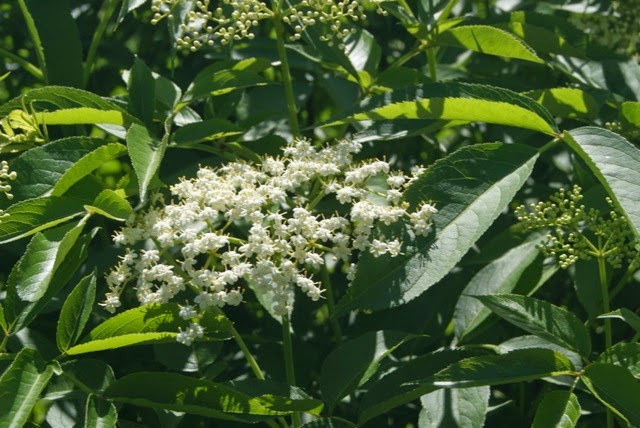
About two months later, early August, the berries begin to ripen and continue to ripen over about the period of a month. Birds adore the berries, especially the Cat Birds in our space. There was a Cat Bird nest in our biggest thicket and while the Cat Bird tolerated us getting somewhat close, he became very distressed when we got too close to his nest. So we gave him a respectful distance, admiring his courage and his wise choice of nesting amid his favorite food!

We collect the berries in baskets and need about 15 pounds to make 5 gallons of wine. This is about 9.6 oz or almost 2/3 rds of a pound per finished bottle of wine. This is a tremendous amount of elderberries per bottle and has high medicinal value!

The berries are pounded in some water in a bucket.

The next day the berries are strained through a cheesecloth and sieve. This is hard work as it is best to get as much of the berry juice out as possible.

Yeast is now added and the bucket is left covered with a cloth for about 10 days to allow the aerobic fermentation process to occur. At this time the aroma is very intense as the house fills with the smell of the fermenting elderberry.

Next the liquid is siphoned from the bucket to a glass carboy which is plugged with an airlock which allows the carbon dioxide produced by the anaerobic fermentation process to escape but does not allow air into the carboy. It is also fed with sugar at this time. This process is repeated again in order to feed the yeast with more sugar.

The wine then continues to anaerobically ferment for an additional 4 months or more! This process requires patience!

When the fermentation process is complete, the wine is siphoned into bottles and corked.

The wine is then labeled and will be used over the coming year or more!

These photos show the "Early Harvest" Wine, the two carboys behind them represent the "Mid Season Harvest", and the "Late Harvest".

One of the challenges of living in a temperate climate where summers are full of lush growth and winters are very barren, is how to store the abundance of summer to be used in winter, especially without refrigeration. In the past fermentation was an essential technique used to store foods and carried tremendous cultural value. The diversity of fermented foods and drinks was vast, going way beyond, cheese, beer, and sauerkraut! Fermentation is re-emerging as people remember its value and reawaken to their need to reclaim their ability to provide for their needs and health. Of course having said this, there are many people who never turned their backs on the Spirit of Fermentation, and never allowed corporations to take control of their food! We honor those people who have held the form for us all, and we honor the Ancestral Spirit who continues to bring to our consciousness these techniques and practices!
Our Elderberries were gifted to us by Mother Earth, probably via a Cat Bird! We never planted them, they appeared and multiplied! It is vital to always be open minded as to what Mother Earth is bringing to us, so that we can embrace her gifts. By being rigid, and saying "oh but Elderberry was not used by Tainos of the past so we won't use it either" we would be rejecting her gift/ blessings and the wisdom that is gained through working directly with our Mother the Earth!
Friday, October 31, 2014


Wednesday, February 5, 2014

Saturday, January 11, 2014
Earth Changes

Our Yearly Divination begins on the Winter Solstice which leads into the solar New Year and soon into the Lunar New Year which is approaching. Our Yearly Divination tells us a great deal on multiple levels, some are personal and others are communal and definitely global. It is a year of the "Egg and the Snake" and a year of issues of Disrespect of Mother Earth coming to a head. We will continue to witness an increasing response from the Misterios, Mpungos, Cemis, or Forces and Phenomenon of Life/ Death who are responding more and more strongly to the abuse and misuse of the Blessings of Mother Earth (Earth's Resources). It is a year to seek Consciousness and Awareness rather than to live in the complacency of ignorance, denial or fantasy. It is also a year to put into action those "plans of action" that have been collecting dust! These plans of action do need to address the reality of Earth Changes and the reality of the breakdown between the relationship of the Living (Two-leggeds) with the Dead and the breakdown between the relationship of the Living (Two-leggeds) with the Living (Life, Earth). Ceremonies and rituals need to be bringing forth real solutions and not to be blind repetitions of empty fantastical rituals. It is a year to look into the mirror with truthfulness and take action.
Earth Changes are undeniably upon us, and as this arctic cold sweeps through our homes and lives, it serves as a serious reminder from the Misterios that the time for taking Mother Earth for granted has passed. Simultaneously, extreme heat is scorching other places upon the Earth, such as Australia. In our home we prefer the term "Earth Changes" rather than "global warming" as the actual experience of this phenomenon is of changes, extremes, unpredictable seasons and increasingly strong storms. This particular deep freeze is termed an "arctic vortex" however how can we understand this on a more profound level and what message does it bring to those who are seeking a greater awareness and consciousness?
The interesting interview below addresses various issues, however the video in it showing the global jet stream as seen from beyond the Earth is of particular interest.
Weather Whiplash: As Polar Vortex Brings Deep Freeze, Is Extreme Weather Linked to Climate Change?
The jet stream is a current of high winds very high above our heads that encircles the Earth. This current of winds is very strong and powerful and holds the weather patterns in balance so that we have fairly predictable weather patterns. The video shows the movement of the jet stream and how it holds the cold weather in the poles, protecting us from experiencing extreme cold. However the video also shows how the jet stream is becoming more and more erratic and is twisting and turning more deeply. This arctic vortex is a deep twist in the jet stream's motion. It is clear from the video that the jet stream can be seen as a SNAKE who is encircling the Earth. The erratic movement of the Snake is like an angry snake whipping its tail around.
We know that traditionally our people had many powerful understandings of the snake and egg, and globally the snake is a powerful symbol of the force of Life. The snake is particularly important to the Ayahuasquero and within Cohoba ritual.
From our Divination we know that the snake is bringing a year of raw energy that will shake apart weak foundations, destroy complacency and denial, reveal hidden truths and unlock energies that have been in potential forms to transform into kinetic forms. This shaking and rocking will reverberate up and down the Ancestral Trees and be felt from the Physical World into the Ancestral World and from the Ancestral World into the Physical World.
As the fabric between the Living and the Dead continues to fall apart due to lack of respect and lack of nourishment and lack of alignment between the Living and the Dead, we continue to see a breakdown within our Spiritual Communities and we continue to see the dilution and prostitution of Ancestral practices. This is nothing new, as this breakdown was introduced into our homelands 500 years ago, however it does continue to progress like a chronic disease. Urbanization has had a devastating impact upon our peoples, and the disconnection from the Earth herself is creating a psychological alienation within the people and within the Spirituality and Spiritual Practices of the People. Although there has been a "Resurgence" among the Taino, this has also created a great deal of inaccurate representations of our Traditions, especially through the internet by those who are uninterested in historical accuracy, who have no spiritual principles or integrity, and those who harbor dangerous fantasies concerning our Ancestors.
One of the critical issues that are arising this year is "Death", the approach and handling of "Death" within our Families and Communities. While our Traditions are deeply rooted in the relationship with the Dead, and we are commonly termed "Muerteros", this relationship stops short when it comes to Death as experienced in the immediate Community and Family. There is a greater comfortability in working with the bone than with the flesh becoming bone, and many of our people conduct themselves as if they are never going to face Death, and the Raw Justice of Death. There are those mis-named "elders, leaders, healers" of our Communities who are consciously creating and distributing fantastical lies concerning our Ancestral Traditions that are taken by those who are ignorant as fact. They are taking modern pop-psychology concepts and applying them to our Ancient Stories in disgusting perversions of our Traditions. However the Life we Lead, leads directly to the Justice of Death, and the conscious propagation of fantasies and lies about our Ancestral Traditions can only lead to to a spiritual abyss at the moment of Death. Our Traditions are not "games" or "play acting", our Traditions are serious, relevant and profound processes that ensure harmony and healthy relationships between the Living and Life and the Living and the Dead.
Above all the reading of this year reminds us that there are consequences to every choice or path we take in life. There are unescapable Ancestral consequences and then there are the consequences we create for ourselves and our Future Generations. In ignorance and under desperate conditions, many of these choices were forced upon us. Through spiritual-mental warfare many of our Ancestors found themselves making harmful choices that have affected the generations into the future. However, to consciously chose to follow and empower a fantasy and distortion is a disgusting betrayal of our Bakulu and Ancient Ancestors as well as a betrayal of the recently "departed." To use our Spiritual Traditions as an "ego trip", to obtain "power over", to utilize "fear tactics of control", to empower degenerate behavior, will create consequences that cannot be avoided or placated. Emerging from this same principle, we see that to continue to abuse our Mother Earth, and to harbor fantasies, illusions, denial and endless rationalizations and excuses regarding the nature of our relationships to her, is bringing us consequences that do not have a cure that lies in the domain of "science" but that lies fully in the domain of Spirituality which then can utilize those techniques and practices that are biologically, ecologically and socially harmonious to adapt to the Earth Changes that are unavoidable.
Tuesday, December 10, 2013
Nfinda Kalunga/ Sacred Burial Grounds

Urban Paleros are accustomed to large city cemeteries, where bodies line up in rows, double or triple deep. These cemeteries have strict hours and access. What is more common out here are many small rural graveyards, sometimes attached to a church, sometimes belonging to an old home or farm, some have as few as a half dozen graves, some have more like a hundred. Many are overgrown with weeds and even become absorbed into the forest. Others are mown by someone once in a while but many are neglected.

We are fortunate that adjacent to our land there is a graveyard (shown in the first 4 photos), where many of the people who tended this whole area now rest. This graveyard was connected to the local "Black Church" which later moved down the road a couple miles. Once in a while we see a car full of people looking for it, but most of the time it is quiet. Most of the bodies in the graveyard are a hundred plus years old. The graveyard is surrounded by forest on 2 sides and unless you venture into the forest you would not realize the number of graves that are right inside the forest at this point and are totally overlooked by whoever is tending the graveyard.

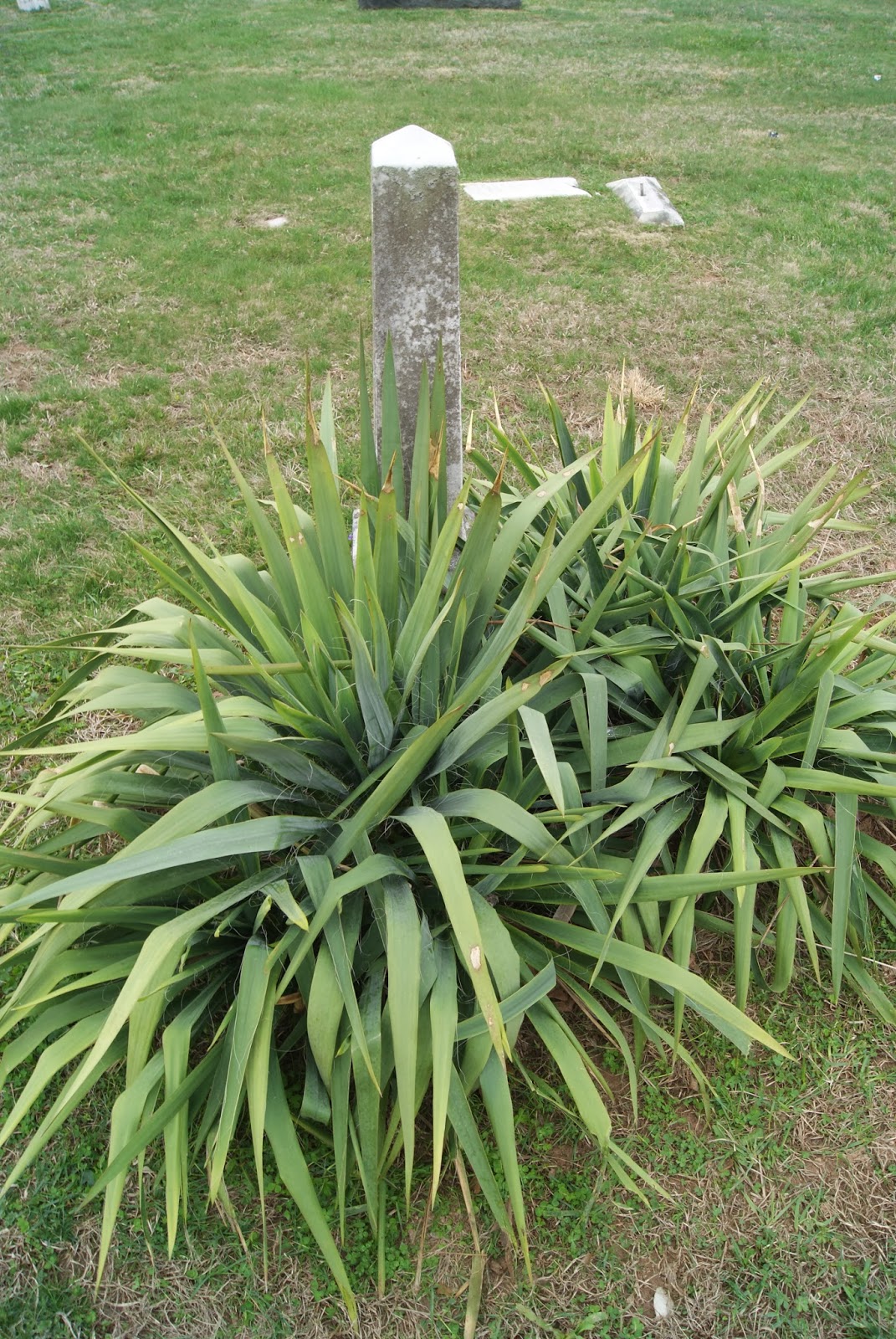
During our visits to the graveyard we noticed the various plants growing and noticed that they had obviously been consciously planted and placed, specifically the YUCCA plant. The YUCCA plant is a native plant, it has spiky evergreen leaves and sends up a tall flowering stalk in the summer which flowers white edible flowers. The leaves can be used to make twine and baskets and more. In some places the gravestone had become swallowed up by the Yucca plants. There are also a number of evergreen trees, especially cedar and native pine, which we know symbolize immortality or everlasting life!

Yucca was used much more in the past in this region by those of African descent and tradition to give protection and grounding to the Spirit of the person in the grave. You see Yucca often planted by specific graves and often at the entrance of the graveyard. You do not see the Yucca typically on graves of those of western religious traditions.

These photos show other graveyards in the area that we have visited which also have patches of Yucca surrounding certain graves. The graveyard adjacent to us has far more Yucca because of course it is connected to the "Black Church". If you drive down the back rural roads and look carefully for old graveyards, there is a strong possibility that you will see graves with Yucca.


 |

Subscribe to:
Posts (Atom)